 Loading

The magazine page photos were developed from stylized visual narratives that incorporated scenes from photos I took at Robert Moses State Park and its iconic 19th Century Fire Island Lighthouse. The model and fashion were generated by AI. As the theme of this project was human-AI partnership, the text was developed in combination from Summer 2026 weather and climate stories and AI.
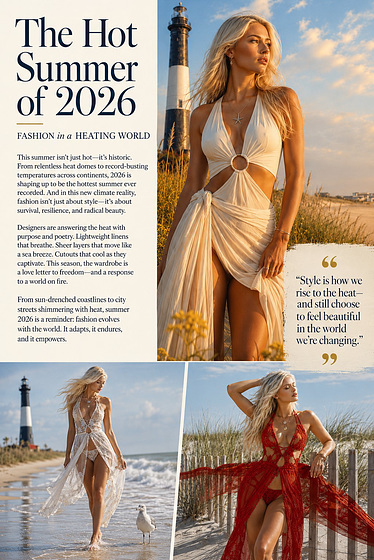
This partnership expands creativity. The prompt’s precise boundaries, such as using only three photographs and avoiding generic brochure styling, show that constraints can make AI more inventive rather than less. The person defines what must be preserved and what the work should communicate, while the AI helps test possibilities that might otherwise remain unexplored. In this model, graphic art becomes a conversation. Human imagination sets the direction. AI accelerates the journey. The finished design reflects the strengths of both.
Prompt:
You are a world-class editorial designer and visual art director.
Your task is to create a single high-quality magazine page with a first-rate editorial layout. The design should feel elegant, polished, visually balanced, and publication-ready, with the sophistication of a premium lifestyle or culture magazine.
STEP 1 — COLLECT REQUIRED INPUTS FIRST
Before creating the page, ask me for the following:
Title information
Main title
Optional subtitle or deck
Optional section label (examples: “Flowers | Culture | Beauty”)
Article text
Ask me to provide the article text I want included.
If I do not have finished text, ask whether I want you to draft the article for me based on the topic.
Quote
Ask me to provide a quote to feature in an inset or pull-quote box.
If I do not provide one, ask whether I would like you to find or create an appropriate quote related to the topic.
Three photos
Ask me to upload exactly three photos.
Use only those three photos.
You may crop, enlarge, zoom, reframe, or artistically adapt them, but do not introduce a fourth photo or unrelated imagery.
Do not generate the final page until all required inputs are gathered.
STEP 2 — CREATE THE PAGE
Once I provide the materials, create a single-page editorial magazine layout with the following qualities:
Overall Style
Refined, elegant, and visually striking
Premium magazine aesthetic
Clean hierarchy and excellent readability
Professional typography and spacing
Beautiful balance between text and image
Sophisticated but not cluttered
Layout Requirements
Create a single-page magazine feature layout
Include:
section label or header line near the top
large, elegant main title
optional subtitle/deck
body article text in well-structured columns
one inset or pull-quote box containing the featured quote
captions or short callouts for the photos when appropriate
Use only variations of the three uploaded photos
Arrange the page so the three photos feel intentional and integrated into the editorial design
It is acceptable to use:
one photo large
one photo medium
one photo as a banner or bottom strip
or other elegant editorial arrangements
You may use cropped or reframed versions of the same three photos, but again no extra image beyond those three source photos
Visual Direction
Enhance the photos tastefully for publication quality
Preserve the identity and beauty of the original photos
Use a harmonious palette derived from the images
Employ subtle decorative accents only if they improve the page
Avoid cheesy templates or generic brochure styling
The final result should look like a luxury magazine page, not a flyer
Text Handling
Ensure all text is clearly legible
Edit the article text lightly if necessary for flow, grammar, or layout fit while preserving meaning
If the supplied article is too long, condense it gracefully
If it is too short, expand it slightly in a professional editorial voice
Make the quote visually distinct in an inset or pull-quote panel
Reliability Constraints
Use exactly three source photos
Do not add a fourth standalone image
Keep the layout to one page only
Make the composition feel balanced and high-end
Ensure the title, text, quote, and photos all work together as a unified magazine page
OUTPUT GOAL
Produce a beautiful, publication-quality, single-page editorial layout that feels like a professionally designed magazine feature.
3 comments
Kayleigh said:
William Sutherland said:
Jean-luc Drouin said:
Si vous ramassez une bombe, elle peut vous exploser à la figure. Il y a déjà des pans entiers ds activités humaines qui sont victimes de l'IA. Pour la médecine, pourquoi pas, mais pour faire des journaux, il n'y a rien de tel pour faire disparaître les professions de journalistes et les photographes.