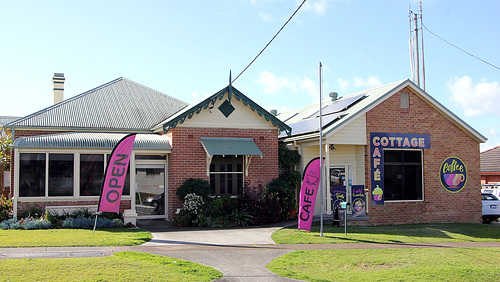
77 Pulteney Street, Taree, NSW Australia
Vacant land having frontages to Pulteney, High and Wynter Streets (Lots 1 & 2 Section B) was sold to John Joseph Stephens of Taree in 1908.
Later that year, Stephens commissioned Henry Alcorn of “Tunbridge Wells” High Street, to build a substantial brick house on Lot 2 which was leased, on completion, to Dr Stuart Kay, a Sydney University graduate...
Over the years, the property changed hands several times. In 1944 John Francis Bradley purchased the dwelling. He and his family operated a bakery and shop nearby at 85 High Street.
The building is presently occupied by Taree Craft Centre Inc. and has been extended to provide space for a teaching area and café. Following damage caused by a vehicle in July 2017, substantial repairs were undertaken, together with the glazing of the front verandah. The building is a locally listed heritage item.
Author: Penny Teerman.
Mid Coast Stories
2 20260702_150202
Sunday challenge 204 - Street Signs
 Loading

15 comments
tiabunna said:
Gillian Everett replied to tiabunna:
Annemarie said:
Happy sunday!
Xata said:
Gudrun said:
Gillian Everett replied to Gudrun:
Amelia said:
Don Sutherland said:
William Sutherland said:
Luc Boonen - PhLB said:
Esther said:
Gillian Everett replied to Gillian Everett:
Pulteney Bridge is a bridge over the River Avon in Bath, England. It was completed by 1774, and connected the city with land in Bathwick which Sir William Pulteney and his family wished to develop. Designed by Robert Adam in a Palladian style, it is one of only four bridges in the world to have shops across its full span on both sides. It has been designated as a Grade I listed building. The bridge is named after Frances Pulteney, wife of the Scottish lawyer and politician Sir William Pulteney, 5th Baronet. Frances was a first cousin once removed of William Pulteney, 1st Earl of Bath. She inherited the Earl's substantial fortune in Somerset after his death in 1764. The rural Bathwick estate, which Frances and William inherited in 1767, was across the river from the city and could be reached only by ferry. William made plans to create a new town, which would become a suburb to the historic city of Bath, but first he needed a better river crossing.
Wikipedia
Gillian Everett replied to Gillian Everett:
Gillian Everett said:
Gillian Everett replied to Gillian Everett: