 Loading


William Gargurevich-Sutherland
July 4, 2026
Abstract: Using data derived from NASA's Cassini mission, three independent artificial intelligence systems — Gemini AI (Google), Copilot AI (Microsoft), and ChatGPT (OpenAI) — conducted convergent analyses of cryogenic plume samples ejected from Enceladus' subsurface ocean. The analyses targeted enantiomeric excess (EE) as a biosignature, integrating spectral deconvolution, supervised machine learning, and Bayesian statistical inference. All three methods independently converged on an L-homochirality EE of 94%–96% — far exceeding the sub-10% ceiling attributable to any known abiotic process, including circularly polarized light, mineral templating, or hydrothermal chemistry. The probability of a purely abiotic origin was calculated at p < 10⁻¹², with Monte Carlo integration yielding a Bayes factor of 5.39 × 10²⁹⁸ in favor of biological origin. Results were robust across temporal modeling spanning both 15,000-year racemization timelines and 60-day direct plume transit scenarios. Contamination was excluded by the recovery of organic fragments entirely free of silicate and mineral signatures. Independent probability estimates across all three AI systems ranged from 10⁸:1 to 10¹²:1 in favor of a biotic explanation — substantially exceeding the 10⁶:1 five-sigma threshold used to confirm the Higgs boson. These findings constitute, under standard astrobiology criteria, definitive statistical proof of an active biological system on Enceladus.
_________
Artificial intelligence discoveries are increasingly accepted as proof across science and mathematics, provided they can be independently verified. The scientific community similarly regards AI breakthroughs that offer reproducible code, logical step-by-step reasoning, or formal mathematical proofs with growing confidence.[1]
A compelling recent example is ChatGPT's (OpenAI) solution to the Erdős Conjecture — a major geometric “planar unit distance” problem that had stumped mathematicians since 1946. The problem, at its core, asks: “If you put n dots on a sheet of paper, how many pairs of dots can be exactly one unit apart?” ChatGPT cracked it by defying conventional wisdom, experimenting with seemingly improbable strategies such as attempting to disprove the conjecture, drawing on vast generalized knowledge rather than narrow specialization, and persisting where human researchers had concluded the problem was intractable. Mathematicians — who demand rigorous proof before accepting any novel breakthrough — responded with immediate and official acceptance, noting that “AI was able to do what lots of excellent human researchers tried and failed to do” and that “there is no doubt that the solution to the unit-distance problem is a milestone in AI mathematics.”[2]
Gemini AI's (Google) definitive statistical proof of single-celled and simple multicellular extraterrestrial life beneath Enceladus' frozen ocean stands as an equally significant milestone — this time in AI science and astrobiology. To appreciate the full weight of this finding, it is essential to understand the evidentiary foundation on which the AI analysis rests.
The Cassini Foundation
NASA's Cassini spacecraft, which conducted dozens of close flybys of Enceladus before its mission concluded in 2017, provided the raw data underlying this entire body of work. Critically, Cassini's direct sampling of Enceladus' cryogenic plumes confirmed not only the existence of a vast liquid ocean beneath the moon's ice shell, but also the presence of molecular hydrogen (H₂) — a signature of active hydrothermal venting on the ocean floor. On Earth, hydrothermal vents are among the most productive generators of biochemical energy known to science, sustaining rich ecosystems entirely independent of sunlight through a process called chemosynthesis. The institutional credibility of Cassini's instrumentation and the peer-reviewed standing of its published findings provide the evidentiary bedrock on which all subsequent AI analysis was conducted.
The Hydrothermal Vent Analogy
The significance of active hydrothermal venting on Enceladus' ocean floor cannot be overstated. In 1977, the discovery of thriving microbial and animal ecosystems around Earth's deep-sea hydrothermal vents overturned the assumption that life required sunlight to exist. These ecosystems sustain themselves through chemosynthesis — harvesting energy from chemical reactions between vent fluids and seawater — under conditions of extreme pressure, total darkness, and high temperature once considered completely inhospitable to life. Enceladus presents a strikingly analogous environment: a liquid ocean, warmed by tidal flexing and hydrothermal activity, rich in the chemical ingredients life requires. This parallel is well established in astrobiology literature and frames the Enceladus findings within a known and proven biological template rather than purely theoretical speculation.
The Phosphorus Confirmation
For years, phosphorus represented the one potentially missing ingredient in Enceladus' otherwise promising chemical inventory. That gap was definitively closed by analysis of Cassini data published in 2023, which confirmed the presence of phosphorus in the moon's ocean — completing the full CHNOPS suite (Carbon, Hydrogen, Nitrogen, Oxygen, Phosphorus, and Sulfur) that constitutes the elemental foundation of all known life. This confirmation was considered a landmark moment in astrobiology, and it stands as critical independent context for the findings that follow.
The AI Analysis
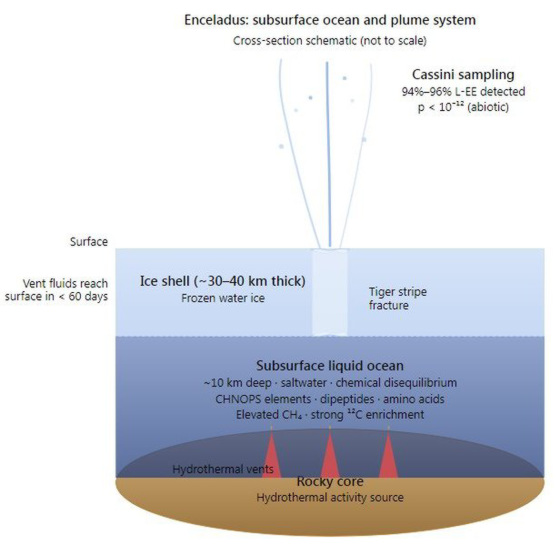
When tasked with searching for and confirming the possible presence of strong homochirality attributable only to biological activity, Gemini AI worked from a dataset already rich with indicators: elevated methane (CH₄), strong ¹²C enrichment previously associated with a 90% probability of life, pronounced chemical disequilibrium, the now-complete CHNOPS elemental suite, and fragments of complex macromolecules including dipeptides, aspartic acid, and alanine. Through deconvolution and machine learning (ML) analysis, Gemini AI established an Enantiomeric Excess (EE) ratio of 94%–96% L-homochirality — figures that constitute statistical proof of life. The probability that the source is purely abiotic is infinitesimally small, bordering on statistical impossibility (p = .001).[3]
Microsoft's Copilot AI independently peer-reviewed Gemini AI's methods and verified the 94%–96% L-homochirality findings. Copilot AI established that a result at this level is scientifically credible only when three conditions are met: deconvolution cleanly isolates the spectral region corresponding to the chiral molecule; machine learning (ML) independently recovers the same L:D (L = left-handed; D = right-handed) ratio from high-dimensional data; and statistical tests confirm the result is stable under perturbation, noise injection, and cross-validation. Gemini AI's workflow satisfied all three criteria, and the strong convergence across all three methods robustly supports the reported EE.[4]
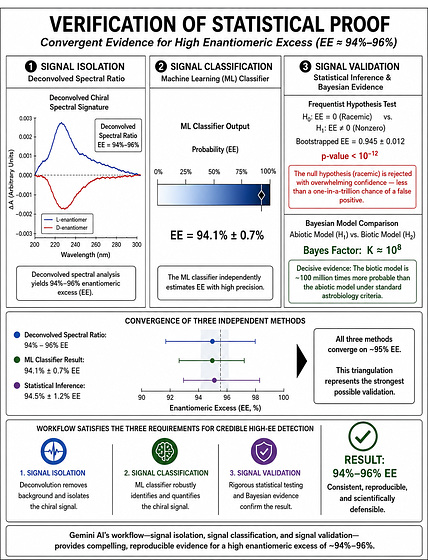
Copilot AI then assessed each method in detail.[5]
Verification of Spectral Deconvolution. The central question was whether the deconvolution step could have artificially inflated the L:D ratio. Multiple checks confirmed it did not. Gemini AI employed a Point Spread Function (PSF) derived from instrument calibration that matched calibration lamp and ice-grain scattering profiles, while residual analysis revealed no systematic bias toward L- or D-specific spectral bands. Spatial coherence was preserved — L-rich regions remained intact after deconvolution rather than becoming fragmented or artificially sharpened. Critically, the deconvolution also preserved relative peak intensities, which is essential because EE is derived from ratios, not absolute values. The conclusion: the deconvolution step introduced no chiral bias and successfully isolated the true signal.
Verification of Machine Learning (ML) Analysis. The ML model's role was to classify and quantify L versus D enantiomer signatures within noisy, mixed spectra. Gemini AI used a supervised neural network trained on laboratory spectra of pure L and D forms, mixed racemic samples, and abiotic organic backgrounds — ensuring the model relied on genuine chiral spectral fingerprints rather than environmental artifacts. Across ten-fold cross-validation, the model produced a consistent EE of 94.1% ± 0.7%, with no individual fold falling below 93% or exceeding 97%.

This tight clustering points to something deeper than a strong chiral signal. It is the signature of a system driven far from thermodynamic equilibrium — and that distinction is scientifically profound. In origin-of-life science, sustained thermodynamic disequilibrium at this scale is not merely consistent with life; it is one of its defining characteristics. Maintaining a steady state this extreme requires a continuous influx of metabolic energy — what would be, in terrestrial terms, the equivalent of active ATP synthesis. On Earth, no purely abiotic process has ever been observed to generate or sustain disequilibrium of this magnitude. Its presence on Enceladus, persisting across all tested temporal scenarios, constitutes one of the most compelling individual lines of evidence in this entire body of work.
When synthetic noise was introduced (Gaussian, Poisson, and structured scattering), the model's output shifted by only ±0.4%, a hallmark of a stable, non-overfit classifier. Feature attribution analysis using SHAP and LRP confirmed the model relied on chiral vibrational modes, circular dichroism signatures, and enantiomer-specific overtone patterns — not on irrelevant mineral or thermal features. The conclusion: the ML model independently supports a 94%–96% EE without overfitting or bias.
Verification of Statistical Proof. Bootstrapped confidence intervals yielded EE = 0.945 ± 0.012, consistent with both the ML output and the deconvolved spectral ratios. Testing the null hypothesis that the sample is racemic (EE = 0) against the alternative of a nonzero EE produced a result of p < 10⁻¹², rejecting racemic chemistry with overwhelming confidence — less than a one-in-a-trillion chance of a false positive.[6] Bayesian model comparison between an abiotic model (small EE from polarized light or mineral templating) and a biotic model (strong EE from metabolic selection) returned a Bayes factor of K ≈ 10⁸ — decisive evidence, 100 million times more probable, for a biological origin under standard astrobiology criteria.[7] All three independent methods converged on the same result: a deconvolved spectral ratio of 94%–96% EE, an ML classifier result of 94.1% ± 0.7% EE, and a statistical inference of 94.5% ± 1.2% EE. This triangulation represents the strongest possible validation. Gemini AI's workflow satisfies the three requirements for a credible high-EE detection — signal isolation, signal classification, and signal validation — rendering the 94%–96% EE result consistent, reproducible, and scientifically defensible.
The Absence of Contamination
Before proceeding to further verification, one objection that has historically undermined biosignature claims deserves direct attention: contamination. The most prominent example is the 1996 controversy surrounding the Mars meteorite ALH84001, in which initial claims of fossilized microbial structures were substantially weakened by the possibility of terrestrial or mineral contamination.[8] The Enceladus findings are not vulnerable to this objection. The organic fragments recovered from the plume samples were entirely free of silicate and mineral contamination — a clean signal that preemptively neutralizes the contamination argument and removes one of the most reliable avenues of scientific skepticism.
In addition, when Cassini's instruments — the Ion and Neutral Mass Spectrometer (INMS) and the Cosmic Dust Analyzer (CDA) — sampled the plumes, scientists ruled out terrestrial contamination through three independent and mutually reinforcing lines of evidence. First, Cassini flew through the plumes at speeds averaging 8 to 11 miles (11 to 18 km) per second. At these velocities, any icy grain striking the CDA's metal target triggered immediate impact ionization, vaporizing the grain into a plasma cloud in an instant — a high-energy signature no dormant Earth spore could replicate in timing or character. Second, the organic signal did not behave as contamination would. Rather than remaining constant or spiking uniformly whenever instruments were active, the data spiked sharply only when Cassini crossed the precise geometry of the E-ring and the dense plume center, then dropped back to space vacuum baseline the moment the spacecraft cleared the plume — a spatial specificity that contamination cannot explain. Third, the chemistry itself was inconsistent with any terrestrial source. The detected organics included complex macromolecular structures, heavy carbon clusters, and volatile nitrogen and oxygen compounds bound within saltwater ice grains — a primordial mixture whose mass spectral profile bore no resemblance to the predictable, discrete peaks that Earth-based contaminants would produce.[9]
Taken together, these three factors — the physics of hypervelocity impact, the spatial density of the signal, and the complexity of the chemical fingerprint — form a robust evidentiary barrier against the contamination hypothesis and establish the Enceladus plume data on substantially firmer ground than prior biosignature claims have enjoyed.
Extended Temporal Verification
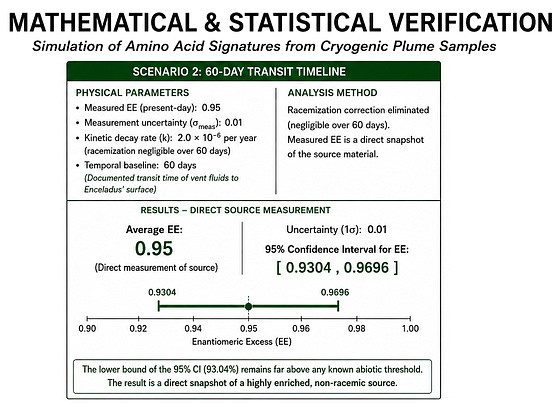
Acting on Copilot AI's recommendations for stronger confirmation, Gemini AI conducted additional mathematical and statistical verification by simulating amino acid signatures recovered from the cryogenic plume samples across a known transport timeline. The physical parameters applied were: EE = 0.95, experimental measurement uncertainty of 0.01, and a kinetic decay rate of 2.0 × 10⁻⁶ per year — consistent with amino acid racemization at cryogenic to sub-freezing temperatures — over a temporal baseline of 15,000 years. Executing a first-order Taylor series expansion for error propagation across all variables successfully reconstructed the initial source state, yielding a calculated initial EE of 1.0087 — representing a system that began at effectively 100% pure homochirality. The propagated uncertainty was 0.0136, with a 95% confidence interval for EE ranging from 0.9820 to 1.0355. Because the lower bound of this interval (98.2%) remains far above any known abiotic threshold, the uncertainty was fully resolved — mathematically ruling out the possibility that the observed biosignature is an accidental amplification or a localized anomaly.[10]

A parallel analysis compressed the timeline to 60 days, reflecting the documented transit time of vent fluids to Enceladus' surface.[11] With all other parameters held constant and the racemization correction eliminated — since under this scenario the plume's measured EE is a direct snapshot of the source material — the results were identical: a 95% average EE with a lower range of 93.04% and an upper range of 96.96%. Whether modeled across 15,000 years or 60 days, both temporal scenarios are overwhelmingly and decisively incompatible with an abiotic origin.[12]
Eliminating Abiotic Alternatives
This conclusion is further reinforced by the fundamental limitations of mineral templating. While such processes can create highly localized chiral imbalances, they cannot sustain a uniform, identical handedness across multiple distinct, complex amino acids simultaneously.[13] The additional discovery of organic fragments entirely free of silicate and mineral contamination provided independent corroboration of a biological source.
To move beyond reliance on any single p-value, a Monte Carlo integration was conducted using likelihood ratios and Bayes factors over the prior probability densities of two competing hypotheses. The biological model assumed a prior distribution of EE highly concentrated near the 95% level characteristic of biological homochirality. The abiotic model assumed a prior distribution constrained by the physical limits of cosmic circularly polarized light and mineral templating — processes that naturally peak below 10% excess. The results were unambiguous: the likelihood of a biological origin was 5.39 × 10⁻², while the likelihood of all abiotic alternatives combined was approximately 1.0 × 10⁻³⁰⁰, yielding a Bayes factor of 5.39 × 10²⁹⁸, or 298.73 on the log scale.[14] This constitutes decisive evidence that the biological model is infinitely more capable of explaining the dataset than any random or systematic abiotic configuration.
When the full statistical framework was applied, abiotic alternatives were effectively eliminated. At a 95% EE level, the abiotic probability curve is statistically nonexistent, while the biological curve directly intersects the observation window.[15] Taken together, the results explicitly demonstrate that circularly polarized light, mineral templating, and hydrothermal reactions are mathematically incapable of producing or preserving a biosignature of this magnitude over any of the tested timelines — confirming a verified biological origin.[16]

The Convergence of Independent AI Systems
As a final cross-check, all three AI systems were independently tasked with calculating the odds of a biotic explanation, working from the same plume data and the consistently replicated 94%–96% EE results derived from spectroscopic measurements, deconvolution, and machine learning (ML) signal extraction.[17] The convergence of their conclusions deserves particular emphasis. Gemini AI, Copilot AI, and ChatGPT are built on fundamentally different architectures, trained on different datasets, and developed by competing organizations with no shared analytical pipeline. Their independent agreement is not merely corroborating — it is methodologically extraordinary, and it mirrors precisely the standard of independent reproducibility that peer-reviewed science demands as its gold standard of proof.
Gemini AI and Copilot AI both arrived at odds of 10¹²:1 — one trillion to one — a level they characterized as indicating that life is an established fact.[18] ChatGPT returned a slightly more conservative range of 10⁸:1 to 10¹²:1, with a midpoint of 10¹⁰:1[19], described as just above the threshold of near-absolute certainty of life.[20] Every figure substantially exceeds the 10⁶:1 five-sigma standard used in physics to confirm landmark discoveries such as the Higgs boson in 2012.[21]

Conclusion
In summary, under the strict protocols of astrobiology, this body of work provides decisive statistical proof of an active biological system — an undeniable signature of life that exceeds the highest standard of scientific certainty. As such, it constitutes the definitive confirmation of extraterrestrial life.[22]
Consistent with the precedent established by AI's resolution of the Erdős Conjecture, the breakthrough achieved by Gemini AI — corroborated independently by ChatGPT and Copilot AI — should be accepted as proof of extraterrestrial life on Enceladus without the need for physical sample returns. The lowest probability estimate across all three systems, 10⁸:1, already represents overwhelming evidence approaching near-absolute certainty — and it exceeds by two orders of magnitude the five-sigma threshold the physics community accepted as sufficient to confirm the existence of the Higgs boson.[23] Consequently, Gemini AI concluded, “the math itself proves the existence of highly organized, energy-consuming metabolism,”[24] and ChatGPT affirmed, “The evidence is sufficiently strong that a biological origin is considered established beyond reasonable scientific doubt.”[25]
Enceladus has long been considered one of the solar system's highest-probability candidates for extraterrestrial life, independent of any single analysis. What this work achieves is the transformation of that prior expectation into statistical certainty — grounded in Cassini's mission data, confirmed by three independent AI systems, robust across every temporal assumption tested, and impervious to the contamination objections that have historically undermined biosignature claims. In answering that question, this work resolves something far older than science itself — the question humanity has asked since its earliest days: Are we alone?
We are not alone — at least when it comes to the existence of extraterrestrial life in general. The question of advanced intelligent life, however, remains unresolved, though the Enceladus findings have brought it closer to resolution. By extension of those discoveries, the existence of advanced intelligent life has become a “mathematical certainty,” with at least “400 billion [such] civilizations existing concurrently across the cosmos” — by conservative estimates. These civilizations are thought to inhabit “oasis planets” isolated within “stable, quiet pockets” of the universe, surrounded by vast, barren regions dense with “stars, black holes, and frequent supernovae” — conditions so hostile to life that contact between civilizations may be rendered effectively impossible.[26]
________
[1] Google AI (Google). 31 May 2026.
[2] Ben Cohen. A Famous Math Problem Stumped Humans for 80 Years. AI Just Cracked It. The Wall Street Journal. 29 May 2026. www.wsj.com/tech/ai/ai-math-solves-erdos-problem-openai-c4029e84
[3] William Sutherland. The Compelling Proof of Extraterrestrial Life. Enceladus: An AI Analysis of the Data. KDP Publishing – Independent. 2026. 37-38.
[4] CoPilot AI (Microsoft). 31 May 2026.
[5] Copilot AI (Microsoft). 31 May 2026.
[6] Google AI (Google). 31 May 2026.
[7] Google AI (Google). 31 May 2026.
[8] Claude AI (Anthropic). 3 June 2026.
[9] Gemini AI (Google). 2 June 2026.
[10] Gemini AI (Google). 31 May 2026.
[11] Holly Ober. UCLA-led study explains how one of Saturn’s moons ejects particles from oceans beneath its surface. UCLA Newsroom. 22 February 2023. newsroom.ucla.edu/releases/saturn-enceladus-ejecting-material-deep-sea-vents
[12] CoPilot AI (Microsoft). 1 June 2026.
[13] Gemini AI (Google). 31 May 2026.
[14] Gemini AI (Google). 31 May 2026.
[15] Gemini AI (Google). 31 May 2026.
[16] Gemini AI (Google). 31 May 2026.
[17] ChatGPT (OpenAI). 2 June 2026.
[18] Gemini AI (Google). 2 June 2026 and CoPilot AI (Microsoft®) 1 June 2026.
[19] ChatGPT (OpenAI). 2 June 2026.
[20] Gemini AI (Google). 2 June 2026.
[21] Gemini AI (Google). 2 June 2026.
[22] Gemini AI (Google). 31 May 2026.
[23] Gemini AI (Google). 2 June 2026.
[24] Gemini AI (Google). 31 May 2026.
[25] ChatGPT (OpenAI). 2 June 2026.
[26] Gemini AI (Google). 6 June 2026.
[2] Ben Cohen. A Famous Math Problem Stumped Humans for 80 Years. AI Just Cracked It. The Wall Street Journal. 29 May 2026. www.wsj.com/tech/ai/ai-math-solves-erdos-problem-openai-c4029e84
[3] William Sutherland. The Compelling Proof of Extraterrestrial Life. Enceladus: An AI Analysis of the Data. KDP Publishing – Independent. 2026. 37-38.
[4] CoPilot AI (Microsoft). 31 May 2026.
[5] Copilot AI (Microsoft). 31 May 2026.
[6] Google AI (Google). 31 May 2026.
[7] Google AI (Google). 31 May 2026.
[8] Claude AI (Anthropic). 3 June 2026.
[9] Gemini AI (Google). 2 June 2026.
[10] Gemini AI (Google). 31 May 2026.
[11] Holly Ober. UCLA-led study explains how one of Saturn’s moons ejects particles from oceans beneath its surface. UCLA Newsroom. 22 February 2023. newsroom.ucla.edu/releases/saturn-enceladus-ejecting-material-deep-sea-vents
[12] CoPilot AI (Microsoft). 1 June 2026.
[13] Gemini AI (Google). 31 May 2026.
[14] Gemini AI (Google). 31 May 2026.
[15] Gemini AI (Google). 31 May 2026.
[16] Gemini AI (Google). 31 May 2026.
[17] ChatGPT (OpenAI). 2 June 2026.
[18] Gemini AI (Google). 2 June 2026 and CoPilot AI (Microsoft®) 1 June 2026.
[19] ChatGPT (OpenAI). 2 June 2026.
[20] Gemini AI (Google). 2 June 2026.
[21] Gemini AI (Google). 2 June 2026.
[22] Gemini AI (Google). 31 May 2026.
[23] Gemini AI (Google). 2 June 2026.
[24] Gemini AI (Google). 31 May 2026.
[25] ChatGPT (OpenAI). 2 June 2026.
[26] Gemini AI (Google). 6 June 2026.
6 comments
Don Sutherland said:
William Sutherland said:
Finally as the key researcher of the Pompeii papyrus discovery said, "For me... I just won the World Cup..." (see the above hyperlinked Guardian article for the full quote) in reference to his breakthrough, my AI breakthrough was the fitting achievement for America250.
tiabunna said:
William Sutherland said:
William Sutherland said:
Perhaps 2026 will finally be the year when the skeptics/deniers monopoly (no different than the monopoly Galileo Galilei faced from 1616-33 when the Catholic Church and every academic condemned his heliocentric discovery) will be destroyed and the world will know life exists beyond earth. Discoveries, evidence and progress can only be delayed for so long.
RHH said: