 Loading

At 2°C of warming, summer no longer arrives. Heat settles over cities like a sealed lid, warping rail lines, emptying playgrounds, and turning night into a second, darker afternoon. Rivers shrink within their banks. Crops wither in fields that once fed millions. Coastlines disappear beneath tides that reach farther inland with every storm.
In one part of the world, families flee walls of fire beneath an orange noon. In another, they climb onto rooftops as floodwater rises past doorways and swallows the street signs below. The climate crisis is no longer an abstraction measured only in graphs or distant projections. It is the taste of smoke in a child’s mouth, the silence of a dry well, the strained hum of an air conditioner as the electrical grid begins to fail, and the homework assignments never completed because another evacuation, blackout, flood, or fire has shattered the ordinary rhythms of life.
The future did not break all at once. It was broken gradually, year by year, warning by warning, decision by decision, while much of the world watched. Worse, it was broken because humanity remained captive to the habits of the past, bound by an addiction to fossil fuels so deeply embedded in its economies, politics, and daily life that even mounting catastrophe struggled to loosen its toxic grip.
On a 40°C July day, thousands of Parisians, joined by visitors from across Europe and around the world, moved beneath the broad, tree-lined promenades of the 8th arrondissement toward the Grand Palais. The monumental Beaux-Arts complex rose before them in stone, glass, iron, and ornament. They passed between its classical columns and beneath its sculpted figures, seeking not only refuge from the unbearable heat but entry into an exhibition titled “Climate, Consequence, and Choice.”
Inside, the air was cool. The story on the walls was not.
For decades, the world’s scientists had understood the danger. They measured it, modeled it, published it, testified about it, and warned with growing urgency. The evidence accumulated. The language sharpened. The consequences began to appear.
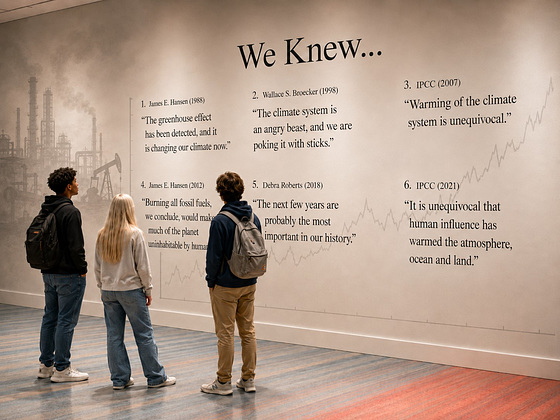
The world did not listen.
It did not listen because denial offered comfort. It promised that nothing fundamental had to change. Its message was seductive precisely because it demanded no responsibility.
“It isn’t happening.”
“Scientists cannot prove that humans are causing it.”
“It is the sun.”
“Carbon dioxide is harmless; it is the gas of life.”
“Nothing can be done.”
These claims were repeated until doubt felt like knowledge and delay could masquerade as prudence. Fossil-fuel interests and allied networks of lobbyists, political organizations, media figures, and advocacy groups helped finance and amplify this fraudulent machinery of confusion. Their objective was to make the truth seem uncertain, the solutions seem dangerous, and inaction seem reasonable.

But physics did not negotiate. It did not change its laws to fit the deniers' narrative.
The world warmed. Arid regions expanded. Soils hardened and cracked. Wildfires grew larger, hotter, and harder to contain. More cities disappeared beneath weeks of smoke. The seas rose almost imperceptibly at first, nibbling at beaches, marshes, roads, and foundations before beginning to consume entire shorelines. Rain fell in heavier bursts. Storm drains failed. Rivers breached their banks. Floods once described as extraordinary became recurring chapters in ordinary life.
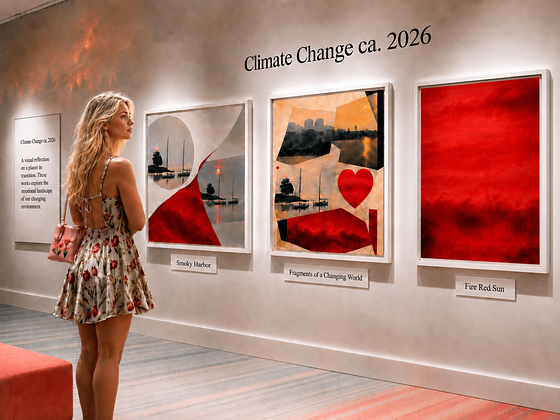
Yet denial had not disappeared. It had evolved.
Where it once said, “Nothing is happening,” it now whispered, “Nothing can be done.”
“It is too late.”
“The damage is irreversible.”
“Individual nations cannot make a difference.”
This new fatalism wore the mask of realism, but it served the same purpose as the old denial: paralysis. Despair became another argument for delay.
Those who moved through the Grand Palais exhibition recognized the emptiness of that claim. They stood before images of ruined towns, scorched fields, flooded streets, burning forests, and coastlines slipping beneath the sea. They read the warnings that had been issued decades earlier. They saw not only what had happened, but how it had happened, and how much of it had been permitted to happen.
By the final gallery, one question remained:
“Now that we have seen and understood, what will we choose to do differently?”
This was the question deeper than blame, more urgent than regret, and more demanding than grief. It transformed knowledge into responsibility.
Humanity still possessed agency. Decades had been squandered, but the future had not yet been fully written. Every fraction of a degree still mattered. Every avoided fire, failed harvest, inundated neighborhood, displaced family, and lost species still mattered. The fact that immense damage had already been done did not mean that greater destruction was inevitable.
Humanity could act. It could break its dependence on fossil fuels, accelerate the transition to cleaner energy, protect vulnerable communities, restore damaged ecosystems, redesign cities, and refuse to treat catastrophe as the price of prosperity. It could choose a future defined not by denial or resignation, but by courage, repair, and restraint.
The question was no longer whether humanity understood the danger. The question was whether understanding would finally be enough. Humanity could still choose a better future. But would it?

2 comments
William Sutherland said:
Mark1965 said: